Dengist Socialism
Pragmatic reform initiated by Deng Xiaoping that introduced markets, private property, and economic opening under the absolute control of the Communist Party, forming the model of socialism with Chinese characteristics.
Home / Ideologies / Dengist Socialism
Pragmatic reform initiated by Deng Xiaoping that introduced markets, private property, and economic opening under the absolute control of the Communist Party, forming the model of socialism with Chinese characteristics.
In one sentence
I want pragmatic socialism, opening markets and private property to enrich the country, under the absolute control of the Communist Party.
Political axes
Leans further toward autocracy than 86% of the 243 ideologies in the catalog.
Of all the axes, Representation is where it stands furthest from the rest.
On Morality, it sits practically at the catalog median.
Here it shares common ground with most ideologies.
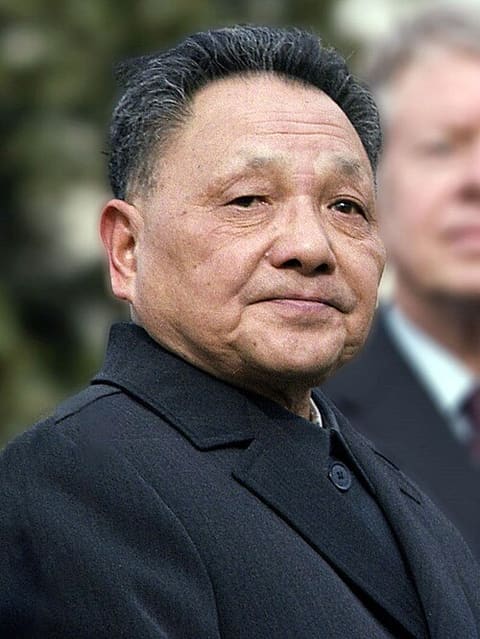
The leader who reoriented China after Mao, Deng promoted market reforms and economic opening under Communist Party control, creating the model of socialism with Chinese characteristics and the country's rapid growth.
Closest, by dimension
Other compatible profiles
The most distant
Reference country
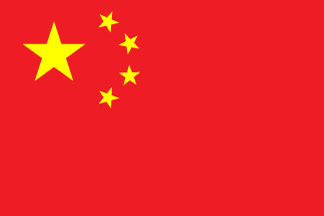
A single-party socialist state, China unites the absolute political control of the Communist Party with a state-directed market economy, becoming a global industrial, technological, and geopolitical power.
Other close countries

A single-party socialist state, Vietnam maintains the Communist Party's political control alongside market reforms that opened the economy, promoting rapid industrial growth and integration into global trade.
Also close, by dimension


The most distant

Under Bashar al-Assad (2000–2024), Syria was a centralized Ba'athist regime sustained by security forces, a clientelist state economy, and alliances with Russia and Iran during the civil war.
Also close, by dimension


The most distant
Ideological proximity
Closest within Left
Model in which the state directs industrialization and economic growth through planning, public investment, and industrial protection, seeking to overcome the nation's backwardness and external dependence.
Early 19th-century current that envisioned an industrial society reorganized by rational planning, led by scientists, engineers and producers, replacing politicians and aristocrats without appealing to class struggle or revolution.
The socialist strand of Zionism that built the State of Israel through the kibbutzim, the Histadrut labor federation, and Ben-Gurion's Mapai party, uniting Jewish nationalism, collective work on the land, and a secular welfare state.
Closest in other spectrums
Model of the Communist Party of Vietnam uniting Ho Chi Minh Thought, anticolonial national liberation and the 1986 Đổi Mới: single-party rule, a socialist-oriented market economy, a dominant state sector and openness to global trade.
Model that entrusts the management of the state and the economy to experts and technological efficiency, combining markets, innovation, and technical decisions instead of political deliberation and traditional party competition.
Model inspired by Park Chung-hee's regime, combining state-led industrialization, credit for private firms, and planning with anti-communist political repression.
The most distant ideology
Anarcho-NaturismAnarchist33%