Keynesian Liberalism
Current inspired by John Maynard Keynes that accepts markets and liberal democracy but gives the state the task of managing demand, with countercyclical public spending, full employment as a goal and a mixed economy.
Home / Ideologies / Keynesian Liberalism
Current inspired by John Maynard Keynes that accepts markets and liberal democracy but gives the state the task of managing demand, with countercyclical public spending, full employment as a goal and a mixed economy.
In one sentence
I want a liberal democracy with a mixed economy, where the state spends against downturns and pursues full employment without owning industry.
Political axes
Leans further toward progressive than 75% of the 243 ideologies in the catalog.
Of all the axes, Morality is where it stands furthest from the rest.
On Structure, it sits practically at the catalog median.
Here it shares common ground with most ideologies.
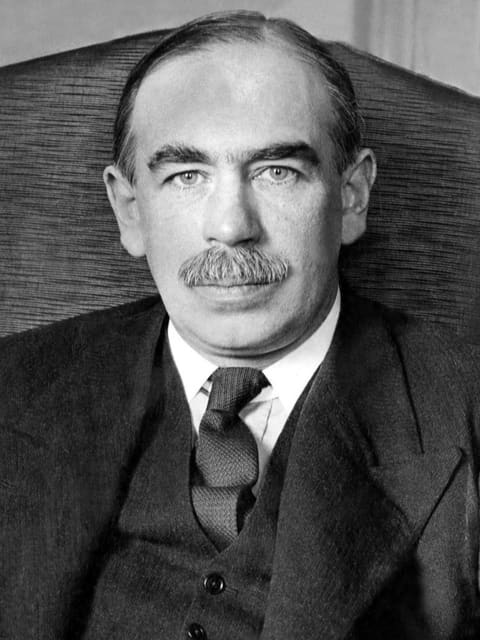
A British economist, Keynes formulated modern macroeconomics and championed the use of fiscal policy, public investment, and demand management to stabilize liberal capitalism without abolishing private property.
Closest, by dimension
Other compatible profiles
The most distant
Reference country

A parliamentary monarchy, the United Kingdom has a long liberal and democratic tradition, a market economy, and a strong financial sector, maintaining global influence after leaving the European Union in the process known as Brexit.
Other close countries
A Nordic parliamentary monarchy, Sweden is a benchmark of social democracy, with a broad welfare state, high taxes, strong social equality, and an open, innovative market economy combined with progressive values.
Also close, by dimension



The most distant
Germany's first democracy, the Weimar Republic united parliamentarism, proportional representation, and intense cultural life, but was undermined by economic crises and political instability that paved the way for Nazism.
Also close, by dimension


The most distant
Ideological proximity
Closest within Left
Liberal current that accepts an active role for the state in the economy and in guaranteeing rights, combining individual freedoms and markets with regulation and public policies aimed at the collective good and equality.
Branch that seeks concrete social results by negotiating with the market and existing institutions, prioritizing responsible fiscal austerity, targeted social policy, and governability over revolutionary ideological purity.
Current that seeks to reconcile capitalism and social justice through democracy, defending regulated markets, a strong welfare state, labor rights, and redistribution to reduce social inequalities.
Closest in other spectrums
Nationalism based on citizenship and shared values rather than ethnicity, defining the nation by adherence to common laws and institutions, open to all who accept its democratic and civic principles.
German liberal school that defends the free market within firm rules guaranteed by the state, fighting monopolies and ensuring competition and stability, serving as the basis of the social market economy.
Model of government in which decisions are made by experts and technical, scientific criteria, entrusting engineers, economists, and scientists with the rational and efficient management of the state and the economy.
The most distant ideology
FeudalismFar-Right28%